Labels

Showing posts with label book reviews. Show all posts

Friday, March 9, 2012

Overcome the Flinch


In a different world, the flinch saved our lives. The instinct that we are all programmed with became a necessary way to escape very real dangers.

Today humans don’t hunt our own food. We aren’t faced with the same types of day-to-day risks that we used to see as survivalists. So do we really need the flinch anymore? That’s the question Julien Smith asks with his free book on Amazon.

This instinct that was necessary for survival for so many years, may be the very instinct preventing you from going where you need to be. Smith, who authored Trust Agents with Chris Brogan, suggests that the Flinch stands between you and your goals.

We all want to lose weight and become healthy. We all want to amass a comfortable amount of wealth. How come we don’t all reach our goals? We flinch at the first amount of discomfort. We stop when we don’t want to sacrifice anymore. In other words, the flinch gets in our way.

Smith offers readers some homework as practice for overcoming this instinct, and understanding that pain from sacrificing for our goals is only temporary. While I have my doubts as to how much of the homework people may actually complete, there’s no question that it will adjust your mindset when faced with adversity.

Those who can overcome the Flinch can reach their goals. The Flinch is a good read for anyone with a goal.   

Thursday, February 23, 2012

Rework The Way You Do Business


Sometimes less is more. That’s exactly the case when the owners of a Chicago software company Jason Fried and David Heinemeier Hansson teamed up to share their ideas on running a business in Rework. Fried and Hansson own 37Signals, a software company that has been profiled in Time, Newsweek and Wired.

The book is filled with short insights into the business world, geared toward helping small business owner find the right balance in their operations. They offer solid advice for anyone looking to run their own operation in today’s world. Most of their insights are extremely helpful.

Consider the idea of working smarter, and not harder. Some workers who work harder create their own problems in order to solve them, and it’s not always practical. Your company isn’t always benefited by a hard-worker. This is what the authors of Rework had to say in their chapter titled Workaholism:

“Workaholics aren’t heroes. They don’t save the day, they just use it up. The real hero is at home because she figured out a faster way to get things done.”

The authors talk about teaching as an alternative to advertising. Big spending companies can afford to advertise. There are plenty of savvy businesses out there out teaching their competition however, and doing just fine. It’s another way to forge a relationship with potential customers.

“Earning their loyalty by teaching forms a whole different connection. They’ll trust you more. They’ll respect you more. Even if they don’t use your product, they can still be your fans.”

In business, sometimes the simplest ideas win. Sometimes it’s the clearest, easiest path to the objective that people need to concentrate on. Many of the ideas in this book are so simplistic and basic, that as a business owner you have probably overlooked them at some point. Or in some cases (such as Workaholism) society wants you to shift your focus.

Rework helps you keep your eye on the prize. It is a powerful tool in helping your business stay efficient in a lean economy. 

Thursday, January 5, 2012

Building Trust


Trust Agents from Chris Brogan and Julien Smith is not a new book, but one that is still a must read for anyone slightly curious about social media and online marketing.

That’s the beauty of this creation. Because the authors focused so heavily on how to build networks, and why they are important, it is a timeless piece at a point where many books in this industry are out of date by the time they go to print.

This isn’t a book about the latest aspects of Facebook and Twitter. It’s not a technologically geeky book about aspects of social media platforms that were created yesterday.

It’s a book that proves once and for all that this new form of interaction is not going away, and if you’re looking to go anywhere in business, you need to be building relationships all the time, and meeting people where they are at—that means online.

How do you build relationships? How do you become an agent of trust? You build armies, reach out and interact with people, and become a human artist, according to the authors. You interact with people, and listen as much as you talk. After all, you need to be someone that people think of, when they have future projects.

Instead of focusing on sheer volume and treating the people in your social networks as a statistic, try interacting. Use mentions in Twitter to start conversations. Ask questions, post interesting content and build relationships.

If you somehow missed this book when it was released in the summer of 2009, go back and check it out. While this may seem like light years ago in the timeline of social media, this book is still a mandatory read for anyone interested in establishing online relationships.

Wednesday, July 27, 2011

TYE Offers a New Way For Doing Business


When we think social media, we think the wave of the future. We think of the interconnectivity that it will provide over the years to come.
Ironically, one lasting effect is that it returns us to the small-town atmosphere that was common in the 50s and 60s. Social media creates one giant, small town, where people talk. Everybody knows what everybody is doing. In a way, the future is like Mayberry.
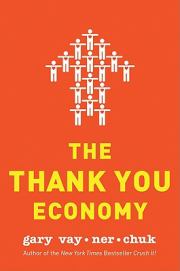
This concept is the main idea behind Gary Vaynerchuck’s newest book, The Thank You Economy. The way the world does business is changing. Instead of pumping marketing dollars into the tried and true mediums of radio and television, companies will do better to invest in a personal platform.
One person can influence thousands in their social network simply by tweeting or posting about their favorite brands, Vaynerchuck writes. Companies can provide a broader, more personal approach by taking advantage of this.
Vaynerchuck uses the example of a theme park. Instead of dumping thousands into a traditional television and radio campaign, they would get more out of providing a “Willy-Wonka” like experience for a handful of customers. There’s a lot of potential for a small group of people with all access to the park, a few cameras and the instruction to post their exploits in their online communities.
The buzz created by this act of good will would resonate deeper than the traditional ad campaign, he argued.
Social media has made consumers more accustomed to this personal level of interaction from businesses. Instead of talking at customers through the traditional “megaphones,” they’ll do better to talk with people on a one-on-one basis. Social media gives consumers leverage in the process again, making customer service hugely important.
Like Crush It, the TYE is also filled with wonderful insight and ideas from someone who is on the forefront of social media. He discusses some current campaigns that have worked well, and some not so well. He discusses several ideas that he has had for businesses and how they can leverage the power of social media.
This book provides an excellent glimpse at the culture social media creates. It’s written for a wider audience than his first book, Crush It, which is more of an entrepreneurial how-to.
I highly recommend this for anyone looking to make sense of the business community moving on in the future.